
Ethics 9 min read
The Animals Nobody Counts: Fishing and Aquaculture
We weigh fish by the tonne, which is how the largest killing of animals on Earth stays invisible.
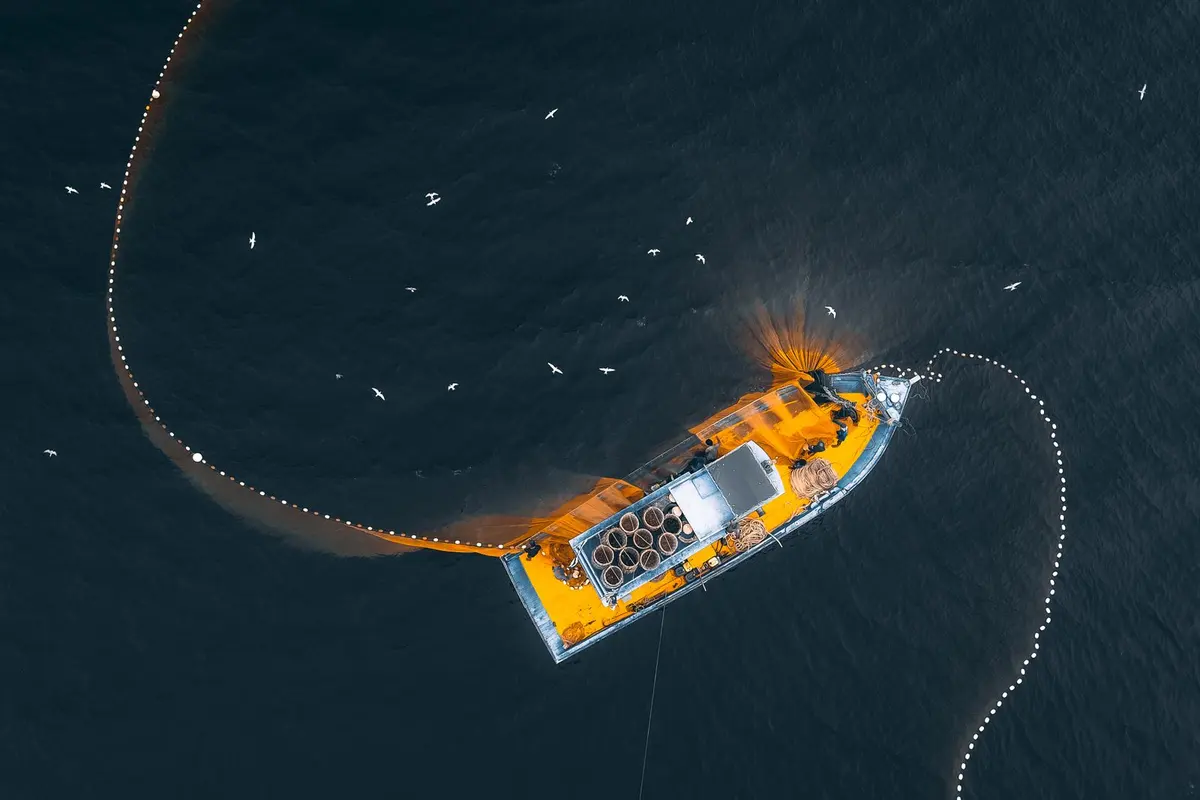
When we talk about how many animals we farm, we count heads. Cattle, pigs, chickens: each is an individual, tallied one at a time, and the numbers are large enough to unsettle people. When we talk about fish, we switch units. A fishery's catch is reported in tonnes. The fish themselves are never counted, because no one has to, and a death toll measured in weight is a death toll that disappears. A million small fish and a single large one can register as the same line on a chart.
Convert the tonnes back into individuals and the scale changes character. One estimate of wild fish caught each year, covering 2000 to 2019, lands at roughly 1.1 to 2.2 trillion (Mood & Brooke 2024). That is trillions, with a wide band of uncertainty, and it is far more individual animals than all the farmed land animals in the world put together. The range is broad on purpose: it is built from reported catch weights and assumptions about the average size of the fish, so it should be read as an order-of-magnitude figure rather than a precise count. Even the bottom of the range dwarfs everything we usually mean by "how many animals do we kill."
Why the number stays hidden
The unit is the whole story. We do not weigh pigs by the tonne when we count slaughter, but for fish, weight is the only figure that gets recorded at the dock. There is no regulatory reason to know how many fish a tonne contains, so no one tracks it. The animals are abstracted into biomass before they ever reach a spreadsheet. That makes the wild fishery the largest direct killing of animals by humans, and also the one we have the least intuitive grip on, because the reporting was never designed to show us the individuals.
What the evidence says these animals can feel
The size of the number only matters morally if there is someone home in each of these animals. For a long time, the easy assumption was that fish do not really feel, that a cold and silent body means a blank inside. The science has moved away from that assumption. Reviews of animal sentience now treat fish as part of the discussion rather than an obvious exclusion, with the question shifting from whether they feel toward what and how much they feel (Proctor 2012). Fish have the nervous systems and the pain-related behavior that the evidence for sentience rests on.
The reach extends past finned fish. When the UK government wanted to know whether the animals we boil and trawl by the billion could suffer, it commissioned a review of more than 300 studies on cephalopods (octopuses, squid) and decapods (crabs, lobsters, prawns). The weight of that evidence led the country to recognize those animals as sentient in law (Birch et al. 2021). These are the animals dropped live into pots and packed live onto ice. The review did not invent their capacity to suffer; it assessed the existing case and found it strong enough to act on.
So the trillion-plus figure is not a count of objects. On the best available evidence, it is a count of animals with the capacity to experience the thing being done to them. That is the part the tonnage hides.
Bycatch: the animals caught by accident
Not everything pulled from the water was the target. Fishing gear is not selective in the way a checkout is, and a large share of what comes up is unwanted: the wrong species or the wrong size, animals with no market. Much of this is thrown back dead or dying. Nets and longlines also take animals that were never the point at all, including turtles, dolphins, and seabirds. These deaths are not recorded as production, because nothing is sold, so they sit even further outside the count than the targeted catch. The trillion-plus figure for wild fish does not pretend to capture them.
The basic problems with fish farming
Aquaculture is often pitched as the fix: farm the fish instead of stripping them from the ocean. It changes some problems and creates others. Many farmed fish are carnivorous, so they are fed on smaller wild fish caught for the purpose, which means farming can pull more animals out of the sea rather than fewer. Fish in farms are held at high density, which brings the disease, stress, and parasite pressure that crowding tends to bring in any animal system. And the welfare question does not soften because the animal is now behind a net: if fish can suffer, and the evidence points that way (Proctor 2012), then confining and slaughtering them at scale raises the same concerns that confinement raises on land. Aquaculture moves the animals indoors, in effect. It does not answer the question of what they experience there.
Holding the number honestly
Two things are true at once, and the honest version keeps both. The first is that the scale is uncertain: 1.1 to 2.2 trillion is a wide range, drawn from catch weights and size estimates, and anyone who quotes a single confident figure is overselling what the data supports (Mood & Brooke 2024). The second is that even the low end is enormous, and it describes animals we now have good reason to think can suffer (Proctor 2012, Birch et al. 2021).
The reason this is the killing nobody pictures is not that it is small or that the animals are simple. It is that we chose a unit that erases them. If you want to follow the reasoning about why sentience is the thing that matters here, rather than size or familiarity, our walkthrough of the common arguments takes them one at a time.
Sources for this article
-
Estimating global numbers of fishes caught from the wild annually from 2000 to 2019
Mood, A. & Brooke, P. (2024), Animal Welfare.
Read the study · In our library (with every article citing it) -
Review of the Evidence of Sentience in Cephalopod Molluscs and Decapod Crustaceans
Birch, J., Burn, C., Schnell, A., Browning, H. & Crump, A. (2021), LSE Consulting (commissioned by the UK government).
Read the report · In our library (with every article citing it) -
Animal Sentience: Where Are We and Where Are We Heading?
Proctor, H. (2012), Animals.
Read the study · In our library (with every article citing it)